
Local SEO
Local SEO for South Wales small businesses: what to fix first

Start by checking that people can find accurate business details, understand your services and contact you easily. Then improve the pages and customer evidence that support those decisions. A useful local SEO plan connects visibility with enquiries.
Separate the problems before choosing the work
“We need better SEO” can describe several different situations. The site might not appear for relevant searches. It might attract visitors who want something you do not offer. Or it might get useful traffic while making an enquiry unnecessarily difficult.
Write down which of these you can actually observe. Check search queries and landing pages in Search Console, then look at the enquiries the business receives. If you do not yet have reliable data, start with the customer journey and build a baseline rather than claiming a precise diagnosis.
1. Check the essentials on your Business Profile
Make sure the business name, contact details, opening hours and service information reflect the actual business. Review categories and photos, and deal with unanswered customer questions. A service-area business should describe its real coverage.
Google identifies relevance, distance and prominence as the main factors in local results. Complete information helps Google understand a business; a blog cannot remove the distance between you and a searcher. See Google's explanation of local ranking.
2. Give each core service a useful page
A long list of services on the homepage usually leaves important buying questions unanswered. Give your main offers enough space to explain the work, who it suits, the process and what a customer should provide when enquiring.
For example, a South Wales installer offering both repairs and replacements should make the difference easy to find. A visitor looking for a small repair should not have to work through a page concerned only with complete installations.
Link each service to a relevant project where you have one. Keep the next step visible and use ordinary language for the button: request a survey, discuss a project or ask for a review.
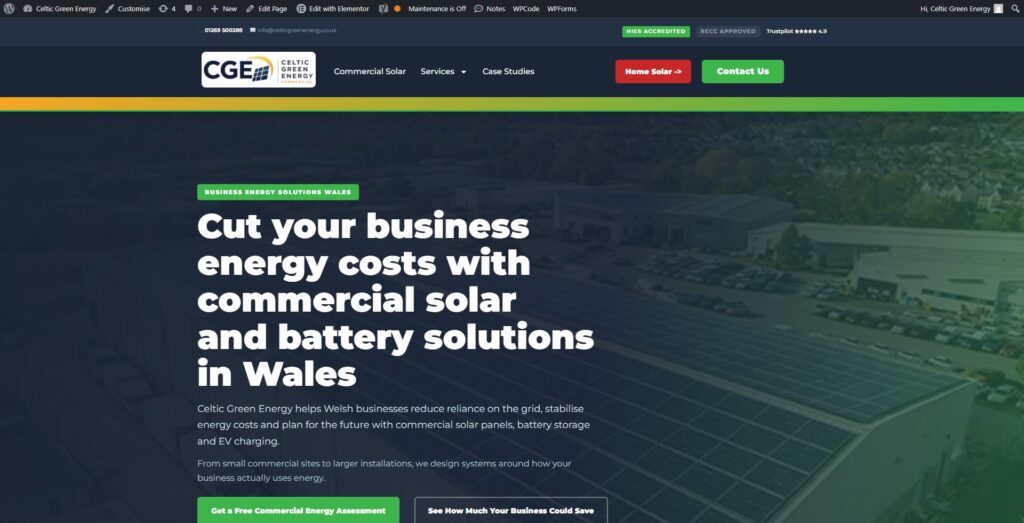
The screenshot above makes the offer and audience explicit. It is included to illustrate service-page communication, not to claim a particular SEO outcome. Read the Celtic Green Energy case study for the project context.
3. Make local pages earn their place
A Swansea page and a Cardiff page should give a visitor a reason to read each one. That might be a relevant project, practical travel arrangements or a particular service delivered there. Do not invent an office, a customer or a local success story to fill the space.
If you have little distinct information for an area, a clear service-area section may be more useful than another near-identical page. Our Swansea marketing support and Cardiff marketing support pages sit alongside the core service information, rather than replacing it.
4. Turn completed work into helpful evidence
Gather the customer's starting problem, the work completed and any approved feedback. Explain the project accurately, including what you did not supply where that could otherwise be misunderstood. Good evidence can support a service page, a case study and a useful article.
A short account of how a real job was handled can help a buyer more than a large gallery with no explanation. Do not add numerical performance claims unless you can substantiate them.
5. Test the enquiry journey on a phone
Open a service page on your phone. Can you read the main message without zooming? Does the phone link work? Are the form labels clear? Can you finish an enquiry, and does the business receive it?
These checks are easy to overlook when the discussion is focused on keywords. They matter because a ranking is only one stage in the customer journey.
A practical first month
Use the first week to record the current position and correct inaccurate details. Improve the most commercially important service page next. Then add one useful piece of project evidence and test the route to an enquiry. Review what changed before choosing the next task.
This is a sensible order of work, not a promise of results within a month. See local SEO and website visibility support if you need help deciding where to start.