
Most small business owners in South Wales have tried at least one marketing tool that promised to fill their pipeline with leads. Many have paid for it, set it up, and watched it deliver almost nothing. The problem is rarely effort. It is almost always a funnel that is either too complicated, too expensive to maintain, or built without a clear understanding of what the customer actually needs to see before they enquire. This guide walks you through exactly how to build a lean, effective lead generation funnel on a modest budget, using practical steps that work for local service businesses right now.
Table of Contents
- What you need to build a low-cost lead generation funnel
- Step-by-step: Setting up your low-cost lead generation funnel
- Top tips for maximising results at every stage
- How to measure, benchmark and improve funnel performance
- What most businesses get wrong with low-cost lead funnels
- How we can help you build a better funnel
- Frequently asked questions
Key Takeaways
| Point | Details |
|---|---|
| Start simple | Use a single form and follow-up process to start your funnel cheaply and effectively. |
| Prioritise offer quality | A compelling lead magnet or freebie outperforms expensive tools in attracting quality leads. |
| Track conversions | Measure and benchmark your results monthly to refine your funnel and improve ROI. |
| Go interactive | Quizzes and chatbots convert much higher than static forms when matched to your customer intent. |
| Focus on follow-up | Fast, relevant follow-up is the highest ROI activity in any low-cost lead funnel. |
What you need to build a low-cost lead generation funnel
Before you spend a single pound on software, it helps to understand what a lead generation funnel actually consists of. Strip it back to basics and you have three moving parts: something that attracts attention, something that captures contact details, and something that follows up. That is it. Everything else is optional until you have proven the core works.
The essential building blocks are:
- A lead capture page or form: This is where a visitor exchanges their contact details for something valuable. It can be a dedicated landing page or simply a well-structured section on your existing website.
- A compelling offer or lead magnet: A free checklist, a short guide, a quote template, or even a no-obligation consultation. The offer must solve a specific problem your ideal customer already has.
- A follow-up method: An email sequence, a direct message, or a phone call. The format matters less than the speed and consistency of the follow-up.
As low-budget lead generation research confirms, low-cost execution is often about reducing tool spend and focusing effort on offer quality, segmentation, and repeatable qualification rather than adding more channels or tools too early. That principle alone will save you hundreds of pounds.
Here is a straightforward table of the tools and assets you actually need to get started:
| Element | Free or low-cost option | What to avoid early on |
|---|---|---|
| Lead capture form | Google Forms, Tally, or existing contact form | Expensive CRM platforms before you have volume |
| Landing page | A page on your current website | Paid page builders with monthly fees |
| Email follow-up | Mailchimp free tier, Brevo free plan | Complex automation sequences before basics work |
| Lead database | Google Sheets or Notion | Full CRM software until you need it |
| Offer/lead magnet | A PDF guide, checklist, or short video | Anything that takes weeks to create |
Notice that nothing in that table costs more than a few pounds per month, and most of it is free. The quality of your offer and the clarity of your message will always outperform the sophistication of your tools. You can find flexible marketing support if you want guidance on which tools suit your specific business type, or explore the full marketing services overview to understand where professional input adds the most value.
Pro Tip: Resist the urge to build three different funnels for three different services. Pick your single most profitable service, build one excellent funnel around it, and only expand once you are consistently generating leads from that first funnel.
Step-by-step: Setting up your low-cost lead generation funnel
With your tools and prerequisites in place, follow these practical steps to launch your funnel without overcomplicating the process.
-
Define your target customer precisely. Not “small businesses” or “homeowners.” Think about the specific person: what problem are they trying to solve this week, what have they already tried, and what would make them trust you enough to hand over their email address or phone number?
-
Choose your lead magnet. Keep it simple and immediately useful. A one-page checklist, a short “what to look for” guide, or a free audit of something you already know how to assess. The best lead magnets solve a problem in five minutes rather than promising to solve everything in fifty pages.
-
Set up your capture point. You do not need a brand-new landing page. As research into simple lead tracking systems shows, lead capture can be cheap and fast by turning existing pages and contact forms into a lightweight lead tracking pipeline with staged statuses and follow-up dates. Add a clear headline, a brief description of the offer, and a short form asking for name and email only.
-
Connect a simple database. When someone submits the form, their details should land somewhere you can see and act on immediately. A Google Sheet with columns for name, email, date, source, status, and follow-up date is genuinely sufficient at this stage.
-
Automate or schedule your follow-up. The freebie lead generation approach works best when you immediately connect the opt-in to a follow-up sequence. Even a single automated email that delivers the lead magnet and introduces your service is far better than silence. If automation feels complex, set a daily reminder to follow up manually with anyone who opted in the previous day.
-
Drive traffic to your capture point. Share it in your Google Business Profile, add it to your email signature, post about it on the social platform where your customers actually spend time, and ask existing clients to share it. Paid traffic comes later, once you know the funnel converts.
Here is a quick comparison of two common approaches for local service businesses:
| Approach | Setup cost | Time to first lead | Best for |
|---|---|---|---|
| Lead magnet funnel | £0 to £20/month | 1 to 2 weeks | Building a list, nurturing longer decisions |
| Direct enquiry funnel | £0 | 1 to 3 days | Immediate bookings, high-intent traffic |
You can see real marketing case studies showing how local South Wales businesses have used both approaches to generate consistent enquiries. If you want to understand how your website can work harder, the section on effective website enquiry pages is worth reviewing before you build your capture point.
Pro Tip: Before creating anything new, check whether your existing website contact form is already receiving traffic. If it is, you may already have the foundation of a funnel. Add a clear offer above the form and track submissions in a spreadsheet. That single change can produce results within days.
Top tips for maximising results at every stage
Now you have set up your funnel, these tips will help you get more from it without spending more money.

First, set realistic expectations. For small local service businesses, a conversion rate of 3 to 7 percent from visitor to lead is a solid result. Reaching 11 or 12 percent is excellent and puts you in the top tier. The median SMB landing page conversion across industries sits at around 6.6 percent, so use that as your starting benchmark rather than chasing an arbitrary number.
Second, consider interactive formats. Interactive lead capture tools such as quizzes and chatbots can materially outperform static forms, but only when the interaction matches the intent of your visitor. A quiz that asks “Which service is right for your business?” can feel genuinely helpful rather than intrusive. A chatbot that fires immediately on every page visit can feel annoying. Match the tool to the moment.
Here are the highest-impact tweaks you can make to any funnel without extra spend:
- Shorten your form. Every additional field you ask for reduces the number of people who complete it. Name and email is almost always enough to start a conversation.
- Deliver value instantly. If someone opts in for a checklist, the checklist should arrive in under two minutes. Delayed delivery kills trust before the relationship has started.
- Write a better headline. The headline on your capture page does more work than any other element. Test a benefit-focused headline (“Get more enquiries from your website this month”) against a problem-focused one (“Stop losing leads to competitors who respond faster”).
- Add social proof near the form. A single sentence from a satisfied client, placed directly above or below your form, can lift conversions meaningfully.
- Set up an immediate automated reply. Even a plain-text email that says “Here is your guide, and here is what we do” is enough to start warming a new lead.
If you want to understand how AI can support your funnel without adding complexity, the page on using AI for marketing funnels covers practical applications for South Wales businesses.
Pro Tip: Track every source of traffic to your funnel from day one. Knowing whether your leads come from Google, social media, or word of mouth tells you where to focus your energy and where to stop wasting time.
How to measure, benchmark and improve funnel performance
Measuring your results is essential for ongoing improvement. Here is how to do it efficiently without expensive analytics tools.
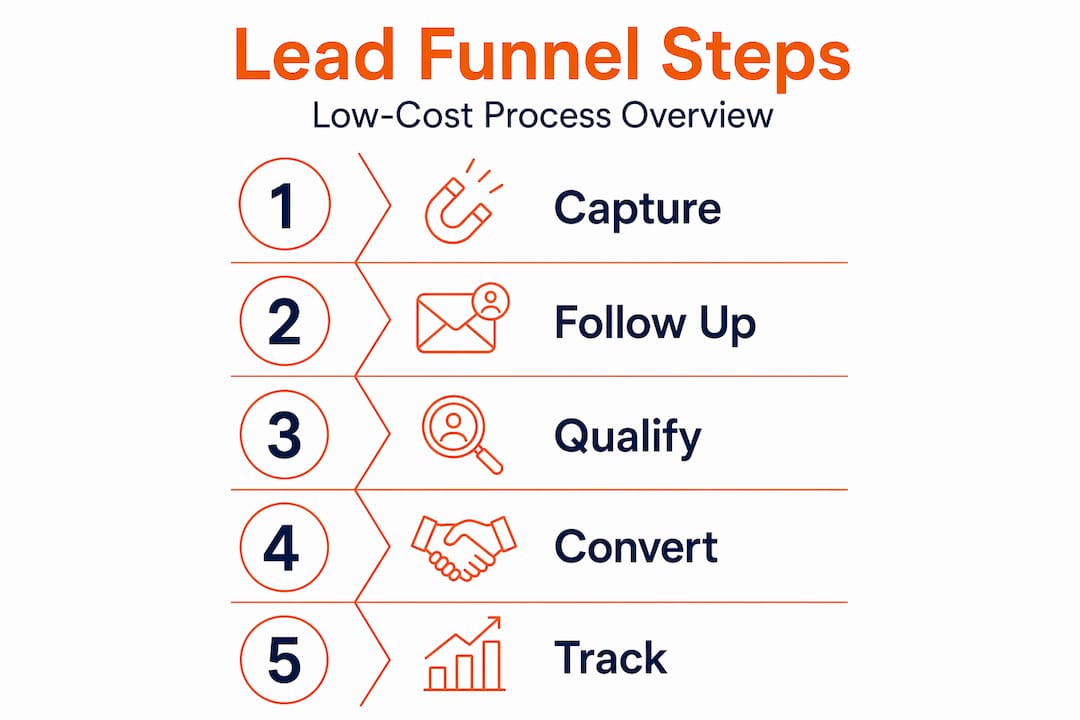
The key metrics every small business funnel should track are:
| Metric | What it tells you | How to track it |
|---|---|---|
| Conversion rate | Percentage of visitors who become leads | Form submissions divided by page visits |
| Qualified lead rate | Percentage of leads who are genuinely interested | Track in your spreadsheet after first contact |
| Follow-up speed | Time between opt-in and first contact | Note the time in your database |
| Cost per lead | Total spend divided by number of leads | Calculate monthly |
| Enquiry to client rate | How many leads become paying customers | Track in your spreadsheet |
Self-benchmarking is straightforward. At the end of each month, calculate your conversion rate and compare it to the previous month. If it is rising, identify what changed and do more of it. If it is falling, look at your traffic source first, because a drop in quality traffic will always lower your conversion rate even if your funnel is unchanged.
“Conversion rate should always be interpreted alongside traffic source and the nature of your ask. A 4 percent conversion from cold social traffic is often stronger than a 10 percent conversion from warm referral traffic, because the audience intent is completely different.”
Know when to add tools or channels. The right time is when:
- You are consistently generating leads and can prove the funnel works
- Lead quality is high and you have capacity to handle more volume
- You have identified a specific gap that a new tool would genuinely fill
Adding tools before you reach that point is how businesses end up paying for software they never fully use. You can find real-world business examples that illustrate exactly when and how local businesses have scaled their funnels effectively.
What most businesses get wrong with low-cost lead funnels
Here is the uncomfortable truth that most marketing content avoids saying directly. The businesses that struggle most with lead generation are not struggling because they lack the right software. They are struggling because their offer is vague, their follow-up is slow or non-existent, and they have never clearly defined who they are actually trying to attract.
Expensive software does not fix a weak offer. A £200 per month CRM will not make a badly written landing page convert. A sophisticated email automation platform will not compensate for a follow-up message that sounds like it was written by a committee. The tool is never the problem.
What actually moves the needle is knowing your audience well enough to write a single sentence that makes them think “that is exactly what I need.” It is testing two versions of a headline and being willing to accept that the one you liked less performed better. It is sending a follow-up email within ten minutes of an opt-in, every single time, because the data consistently shows that speed of response is one of the strongest predictors of conversion.
The case study lessons from local South Wales businesses bear this out repeatedly. The businesses that generate the most consistent enquiries are not the ones with the most sophisticated funnels. They are the ones with the clearest message, the most relevant offer, and the most reliable follow-up process.
Many businesses also underestimate how much money they leave on the table by ignoring the first follow-up. That initial message, sent immediately after someone opts in, is the single highest ROI activity in the entire funnel. The lead is warm, their attention is on you, and they are expecting to hear from you. Missing that moment is a costly mistake.
Pro Tip: Automate your first follow-up email before you do anything else. Even if the rest of your funnel is entirely manual, that one automated message will consistently outperform any other single improvement you make.
How we can help you build a better funnel
Building a funnel that actually generates enquiries takes clarity, consistency, and a clear understanding of what your customers need to see before they act. Getting that right on the first attempt is genuinely difficult without experience.
At Jamie Lewis Marketing, we work directly with small and medium-sized businesses across South Wales to build marketing strategies that produce measurable results without unnecessary spend or complexity. Whether you need expert marketing guidance to clarify your positioning, SEO support for South Wales to bring more of the right traffic to your funnel, or a practical marketing strategy that ties everything together, we can help you move forward with confidence. Get in touch for a straightforward conversation about where your funnel is losing leads and what to do about it.
Frequently asked questions
What is the cheapest way to capture leads for a small business?
Turning your existing website contact form into a simple lead tracker and pairing it with a free offer is the most affordable starting point. Lead capture can be cheap by using existing pages as a lightweight pipeline, and a freebie approach exchanging something valuable for an email address costs nothing to set up.
How do I know if my lead generation funnel is performing well?
A good result for most local service businesses is a conversion rate of 6 to 7 percent, with strong performers reaching 11 to 12 percent. The median SMB conversion rate across industries sits at around 6.6 percent, so use that as your initial benchmark and adjust based on your specific traffic source and offer type.
Should I use quizzes or chatbots instead of forms?
Interactive formats can significantly outperform static forms, but only when they match what your visitor is looking for. Quizzes average around 47 percent conversion versus under 3 percent for static forms, though results depend heavily on how well the interaction fits your audience’s intent.
What is a lead magnet and how should I use one?
A lead magnet is a free resource, such as a checklist, template, or short guide, offered in exchange for a potential customer’s contact details. The freebie lead generation method works best when the free offer directly addresses a problem your ideal customer is already trying to solve, and is immediately followed by a warm, relevant email sequence.