
Most small businesses in South Wales have no shortage of marketing ideas. The problem is that those ideas never quite connect to results. You post on social media for a few weeks, tweak your website, maybe run a Google ad, and then wonder why the phone still isn’t ringing. The missing piece is almost never more activity. It’s structure. A marketing roadmap gives you that structure, turning scattered efforts into a clear, sequenced plan that builds visibility and generates consistent enquiries. This guide will show you exactly what a roadmap is, what goes into one, and how to build yours from scratch.
Table of Contents
- What is a marketing roadmap?
- Key components of an effective marketing roadmap
- Why marketing roadmaps boost visibility and enquiries
- How to build a practical marketing roadmap for your business
- The uncomfortable truth: why most roadmaps get ignored (and how to fix it)
- Get expert help bringing your marketing roadmap to life
- Frequently asked questions
Key Takeaways
| Point | Details |
|---|---|
| Roadmap vs task list | A marketing roadmap ties strategy to actionable steps and timelines, not just tasks. |
| Key components matter | Clear goals, set timelines, actionable initiatives, and success metrics drive results. |
| Boosts visibility and enquiries | Structured roadmaps help businesses get found online and generate more leads. |
| Review and adapt | Regularly review and update your roadmap to respond to real results and new opportunities. |
What is a marketing roadmap?
Many business owners confuse a marketing roadmap with a content calendar or a to-do list. They’re not the same thing. A content calendar tells you what to post and when. A to-do list tells you what tasks need doing. A marketing roadmap does something more important: it connects your business goals to the specific marketing activities that will help you reach them, laid out across a realistic timeline.
As defined in roadmapping practice, “a marketing roadmap is a visual strategic plan that connects business goals to marketing initiatives over time.” That word connects is doing a lot of work. It means every initiative on your roadmap has a reason for being there, tied directly to something you’re trying to achieve in your business.
Here’s what a roadmap is not:
- A list of tasks without priorities or timelines
- A content calendar that only covers social media
- A one-off document you create and never look at again
- A wish list of marketing activities with no clear objectives
A good roadmap is a living document. It should evolve as your business grows, as you gather performance data, and as the market shifts around you. Think of it less like a contract and more like a navigation system. You set a destination, you plan the best route, but you stay alert to diversions and update the route when needed.
For small businesses seeking marketing guidance that actually translates into enquiries, the roadmap is where strategy becomes actionable. Without it, even the best marketing ideas tend to fizzle out because there’s no framework holding them together.
“The businesses that get consistent results from marketing are rarely the ones doing the most. They’re the ones doing the right things in the right order.”
Key components of an effective marketing roadmap
Now that you understand what a roadmap is, let’s break down what actually goes into one. There are four core components that every effective marketing roadmap should include, regardless of business size or industry.
- Goals — What are you trying to achieve? These should be specific and measurable. “Get more customers” is not a goal. “Increase website enquiries by 30% over the next six months” is.
- Initiatives — These are the marketing activities or campaigns you’ll run to reach your goals. Examples include launching an SEO campaign, redesigning your website, creating a case study series, or running a targeted Google Ads campaign.
- Timelines — When will each initiative start and finish? Assigning realistic timeframes prevents the common problem of everything being “in progress” indefinitely.
- Metrics — How will you measure success? Each initiative needs at least one key performance indicator (KPI) so you can tell whether it’s working.
Marketing roadmap components typically include “measurable goals tied to timelines, plus the marketing initiatives and success metrics needed to track progress.” Without all four components working together, your roadmap loses its strategic value and becomes just another document.
Here’s a simple summary of how each component functions:
| Component | Purpose | Example |
|---|---|---|
| Goals | Define what success looks like | Increase organic traffic by 40% in 6 months |
| Initiatives | Identify the activities to get there | Launch local SEO campaign targeting South Wales |
| Timelines | Set realistic start and end points | Month 1 to Month 3 |
| Metrics | Measure progress and impact | Monthly website sessions, enquiry form submissions |
You’ll notice these components interlink. Your goals inform which initiatives make sense. Your timelines make the initiatives manageable. Your metrics tell you whether the whole thing is working. Pull out any one of these and the roadmap loses its coherence.
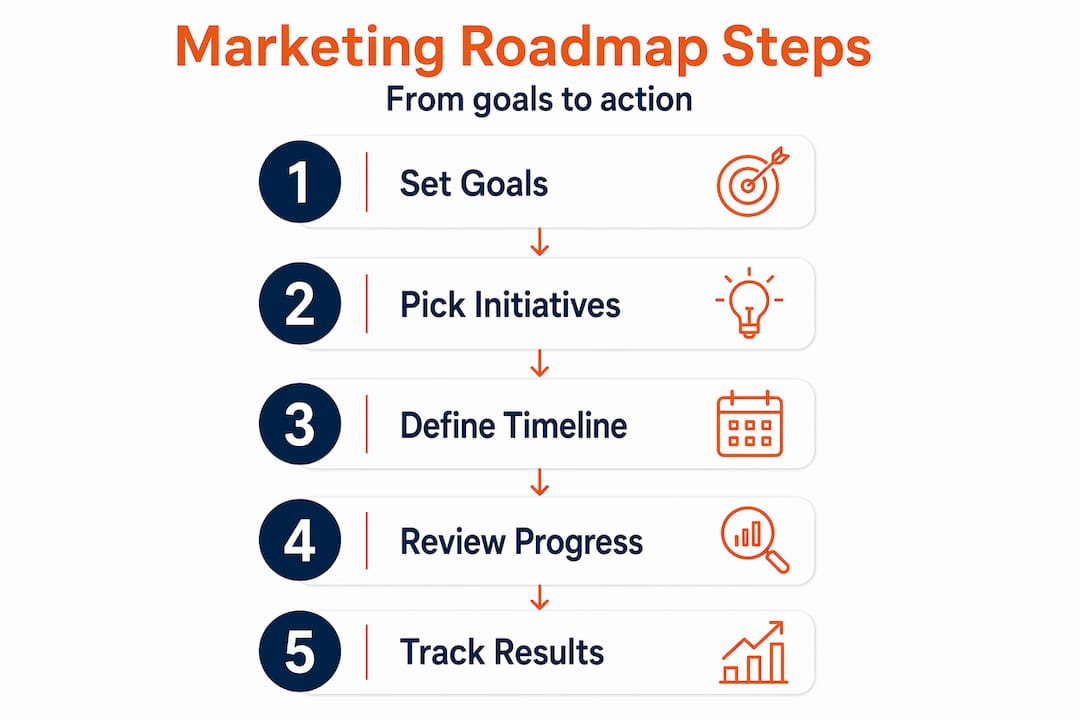
For deeper insight into how these components work in practice, strategy consultant insights show how South Wales businesses have used structured planning to shift from guesswork to measurable growth. You can also review real business examples to see how these components have been applied in practice.
Pro Tip: Build at least one formal review point into your roadmap every quarter. This isn’t a sign of failure; it’s how you keep the roadmap relevant. Markets change, budgets shift, and some initiatives simply outperform others. A scheduled review lets you reallocate effort where it’s having the most impact.
Why marketing roadmaps boost visibility and enquiries
With the pieces of a roadmap understood, why do they make such a difference for small businesses? The short answer is that structure produces consistency, and consistency is what search engines and potential customers both respond to.
When your marketing activities are planned in advance and tied to clear goals, you stop reacting and start building. That shift matters enormously for online visibility. Google rewards websites that publish relevant content regularly, earn backlinks steadily, and improve their technical performance over time. None of that happens by accident. It happens because someone planned it.

Marketing roadmaps “help teams align and prioritise, bridging higher-level marketing strategy with day-to-day execution.” For a small business owner wearing multiple hats, that bridging function is invaluable. It means you’re not starting from scratch every Monday morning wondering what to do next.
The tangible outcomes businesses typically see when they commit to a roadmap include:
- Higher website traffic from consistent SEO and content activity
- More enquiries because your messaging is clearer and your visibility is stronger
- Better return on investment because you’re spending time and money on activities that are tied to goals
- Reduced stress because you have a plan rather than a reactive to-do list
- Stronger positioning in local search results over a sustained period
For South Wales businesses looking at marketing solutions for SMEs, the roadmap is often the first thing that needs to be put in place before any individual tactic will stick. SEO without a roadmap is just guesswork. Content without a roadmap is just noise.
Pro Tip: Track your key metrics monthly and create a simple one-page summary. When you can see that organic traffic grew by 18% in month two and enquiries doubled in month three, you have the evidence to justify continued investment and to make smarter decisions about where to focus next.
How to build a practical marketing roadmap for your business
Ready to create your own? Here’s how to build a marketing roadmap that actually works in the real world, without needing a marketing team or expensive software.
- Clarify your business goals — Start with what you want the business to achieve in the next 6 to 12 months. Revenue targets, new service launches, geographic expansion. These become the anchors for everything else.
- Audit your current marketing — What’s working? What’s being ignored? Where are you visible online and where are you invisible? A quick audit prevents you from repeating mistakes.
- Identify your key initiatives — Based on your goals and audit, choose three to five marketing initiatives that will have the biggest impact. Don’t try to do everything at once.
- Choose your time horizon — Roadmaps are usually expressed “in a practical planning horizon, often quarterly or 6 to 12 months, so they stay actionable for lean teams.” A 90-day roadmap is a great starting point if you’ve never built one before.
- Assign timelines and owners — Even if you’re a solo operator, each initiative needs a start date, an end date, and someone responsible for it.
- Define your success metrics — As a rule, ensure your roadmap “explicitly defines success metrics and the measurement cadence.” Decide in advance how you’ll measure each initiative and how often you’ll check in.
- Schedule your review points — Put quarterly reviews in your diary now. Treat them as non-negotiable.
It helps to understand how a roadmap differs from other planning tools you might already be using:
| Tool | Focus | Time horizon | Strategic value |
|---|---|---|---|
| Marketing roadmap | Goals linked to initiatives | 3 to 12 months | High |
| Content calendar | Publishing schedule | Days to weeks | Medium |
| To-do list | Task completion | Today to this week | Low |
The most common mistakes businesses make when building their first roadmap are setting vague goals (“improve our social media presence”), skipping the metrics entirely, and building the roadmap in isolation without input from anyone else in the business.
If you want to see how a website roadmap illustration works in a real context, or explore an SEO roadmap strategy applied to a South Wales business, both offer useful reference points for structuring your own plan.
Pro Tip: Involve at least one other person in building your roadmap, whether that’s a business partner, a trusted employee, or an external consultant. People support what they help create. A roadmap built in isolation is far more likely to be ignored when things get busy.
The uncomfortable truth: why most roadmaps get ignored (and how to fix it)
Here’s something most marketing guides won’t tell you. Even businesses that build a solid roadmap often abandon it within six weeks. Not because the roadmap was wrong. Because it was never truly integrated into how decisions get made day to day.
A roadmap filed in a shared drive and reviewed once a year is not a roadmap. It’s a document. The difference between a roadmap that drives results and one that gathers digital dust comes down to one thing: whether it’s consulted when decisions are being made.
In my experience working with small businesses across South Wales, the roadmap fails when it becomes disconnected from reality. The business wins a big contract, the priorities shift, and nobody updates the roadmap to reflect that. Or the roadmap was built on assumptions about what customers want, and when those assumptions turn out to be wrong, nobody revisits the plan.
The fix is straightforward, though it requires discipline. Treat your roadmap review like a financial review. You wouldn’t go six months without checking your cash flow. Don’t go six months without checking whether your marketing is on track. When you sit down to review, ask honest questions. Which initiatives are actually driving enquiries? Which are consuming time without producing results? What do the metrics actually say, not what you hoped they would say?
The businesses that get the most from their roadmaps are the ones willing to have that uncomfortable conversation with themselves. They adapt. They cut what isn’t working. They double down on what is. That kind of agile, evidence-based approach is what separates businesses that grow steadily from those that stay stuck despite doing a lot of marketing activity.
For SME marketing solutions that support this kind of ongoing strategic thinking, the goal is always the same: fewer activities, better aligned, producing measurable results.
Get expert help bringing your marketing roadmap to life
Building a roadmap is one thing. Knowing which initiatives will actually move the needle for your specific business, in your specific market, is where experience makes a real difference.
At Jamie Lewis Marketing, we work with small and medium-sized businesses across South Wales to build practical, results-focused marketing roadmaps. Whether you need SEO services for South Wales businesses to improve your search visibility, or practical marketing consultancy to sharpen your positioning and messaging, we focus on what will actually drive enquiries rather than what looks impressive on paper. You can also browse success stories from Wales to see the kind of outcomes that structured, strategic marketing produces for businesses just like yours.
Frequently asked questions
How is a marketing roadmap different from a marketing plan?
A marketing roadmap visualises the timing and connection of activities, while the plan contains the detailed strategy and tactics behind them. As defined in roadmapping practice, a roadmap is a “visual strategic plan that connects business goals to marketing initiatives over time,” making it easier to communicate and act on.
How often should you update your marketing roadmap?
Update your roadmap at least quarterly or whenever significant results or market changes occur. Roadmaps are most effective when expressed within a “practical planning horizon, often quarterly or 6 to 12 months,” keeping them relevant and actionable for smaller teams.
What is the typical time horizon for a marketing roadmap?
Most marketing roadmaps cover 3, 6, or 12 months to stay focused and manageable. Quarterly or 6 to 12 month horizons are the most common for lean teams because they balance ambition with realism.
What happens if you don’t use success metrics in your roadmap?
Without clear success metrics, it becomes almost impossible to prove impact, improve your activities, or justify future marketing spend. Defining success metrics and a regular measurement cadence is essential for any online-visibility roadmap to deliver genuine value.